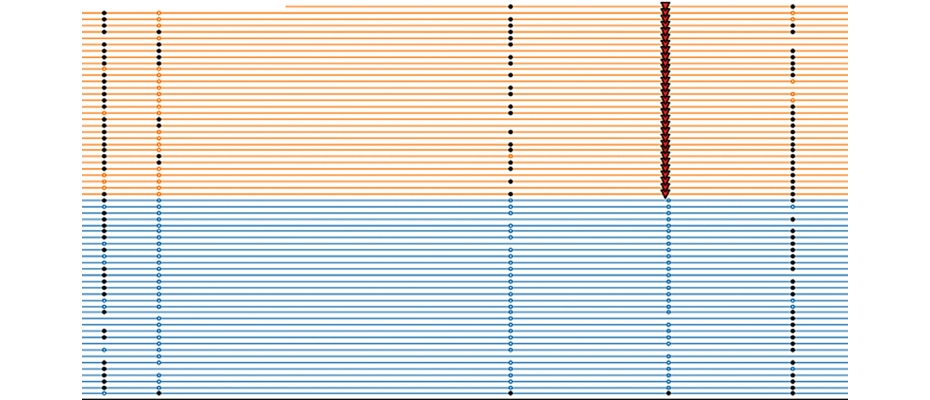
- The new bioinformatics method analyses thousands of genomic loci by grouping long-read sequencing reads according to their methylation patterns, without requiring phasing or genetic variant information.
- The innovative software helps researchers pinpoint promising genomic regions for further study, contributing to a better understanding of human biology and paving the way for the identification of epigenetic variants involved in disease.
- Published in NAR Genomics and Bioinformatics, the tool was developed by researchers from CNAG's Functional Genomics Team and Bioinformatics Development and Statistical Genomics Team.
November 18, 2026. Each of us is born with around 80,000 coding and non-coding genes and, for nearly every gene, we inherit two copies: one from our mother and one from our father. These copies, known as alleles, are not always regulated in the same way. DNA methylation, a chemical mark that helps control whether a gene is active or silenced without altering its sequence, can give rise to differences between the two alleles, a phenomenon known as allele-specific methylation (ASM). These differences can result from mechanisms such as genomic imprinting, where gene activity depends on whether an allele is inherited from the mother or the father, or through genetic variants. All in all, these epigenetic variations can influence gene expression and play a key role in disease development.
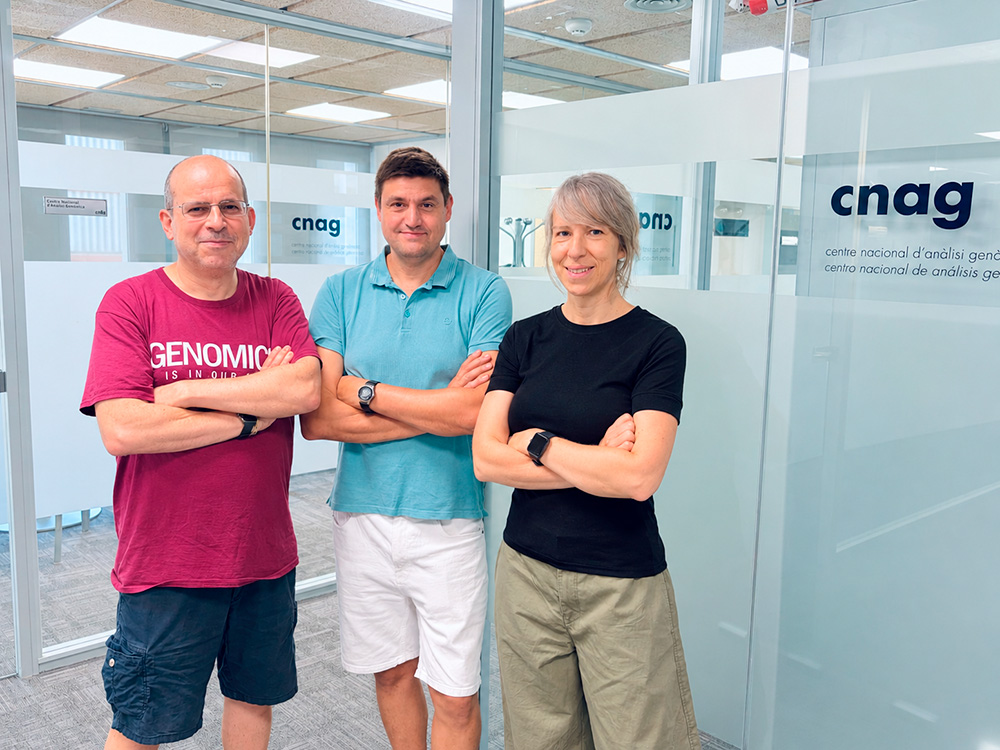
Previous methods to identify ASM have relied on phasing, a computational process that uses genetic variants to determine which allele is inherited from the mother and which from the father. However, this approach can be computationally demanding and may be less effective in genomic regions with low genetic variability. To overcome these limitations, researchers at CNAG have developed asms (Allele-Specific Methylation Scanner), a new bioinformatic tool that identifies ASM patterns without requiring phasing and genetic variant information, published now in NAR Genomics & Bioinformatics. The main advance lies in its ability to efficiently analyse thousands of specific regions of the human genome or genomic loci, either from selected areas or across the entire genome, by grouping sequencing reads according to their methylation patterns.
“The genome still contains many regulatory regions that remain largely unexplored," highlights Dr. Anna Esteve Codina, Functional Genomics Team Leader and corresponding author of the study. "asms helps us identify where allele-specific methylation is likely to be occurring, revealing the genomic regions with the greatest potential for discovery. By focusing future research on these regions, we can better understand the mechanisms underlying human disease and uncover new opportunities for diagnosis and treatment."
“Allele-specific methylation reflects an epigenetic difference between the two copies of a genomic region,” explains Emanuele Rainieri, first author of the study and researcher in the Bioinformatics Development and Statistical Genomics Team at CNAG. “These differences can arise through several biological mechanisms, including genomic imprinting, X-chromosome inactivation, cis-regulatory genetic variation and disease-associated epigenetic dysregulation. By systematically identifying these regions, ASMS provides a framework for investigating how allele-specific regulation contributes to normal biology and human disease.”
In this regard, asms supports two complementary workflows. The first scans methylation data, grouping long sequencing reads according to their methylation patterns to identify regions showing methylation heterogeneity. Besides highlighting candidate regions for ASM, this approach can also distinguish methylation patterns associated with different cell types or cellular states within the same sample, revealing regulatory signals that conventional phasing-based approaches may overlook. The second workflow complements the first by incorporating genetic variant information, enabling researchers to confirm ASM while ruling out methylation differences driven by cellular heterogeneity.
Freely available as an open-source tool on
GitHub, asms has been validated using Oxford Nanopore Technologies (ONT) sequencing data and
can be applied to data generated by any sequencing platform that stores DNA base modifications in BAM files using MM and ML tags. Taken together, the innovative method represents a
new step towards advancing our understanding of the epigenetic mechanisms underlying human disease. By identifying genomic regions that show allele-specific methylation, asms can help researchers investigate how epigenetic differences between the two alleles influence gene regulation and contribute to disease. These regions provide valuable targets for further research in conditions ranging from rare diseases to cancer, where disrupted allele-specific methylation may reveal previously unrecognised regulatory mechanisms.
REFERENCE ARTICLE
Emanuele Raineri, Miguel Ángel Esteve Marco, Eloi Casals, Anna Esteve Codina, asms: finding allele-specific methylation in human genomes without phasing, NAR Genomics and Bioinformatics, Volume 8, Issue 3, September 2026, lqag072,
https://doi.org/10.1093/nargab/lqag072.