- Helping researchers discover relevant clinical data across institutions using different data models can open new opportunities for collaboration in precision medicine. A CNAG-led study offers practical ways for IMPaCT-Data partners using OMOP to make their data discoverable to other partners too.The approach was tested on three datasets, including hospital records covering more than one million patients, with high levels of data preservation.
- The work extends opportunities for data discovery beyond centres that use the same clinical data model, helping connect a wider research community.
November 5, 2026. Many
IMPaCT-Data partners use the OMOP Common Data Model to organise their clinical research data. This common model already supports data sharing between centres that use it. Other partners organise their data differently.
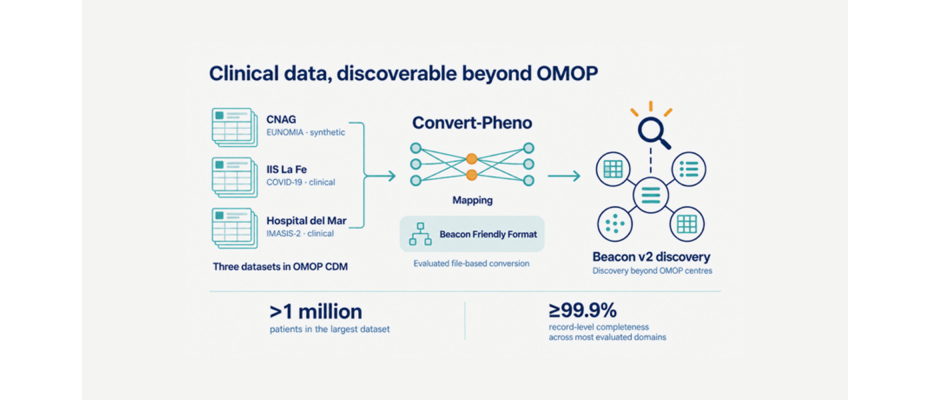
This study examines how OMOP data can be made discoverable through Beacon v2, an international standard from the Global Alliance for Genomics and Health (GA4GH), so that discovery can extend to partners using other data models.
The aim is to help researchers identify where relevant data are held across the wider IMPaCT-Data community.
The study, led by CNAG in collaboration with
Instituto de Investigación Sanitaria La Fe (IIS La Fe),
Hospital del Mar and the
Barcelona Supercomputing Center (BSC),
evaluated a file-based approach using the Convert-Pheno tool, developed by CNAG. It prepares a copy of OMOP data in a format that can be searched through Beacon v2, with updates when needed. Researchers tested it on a synthetic dataset at CNAG and clinical datasets from IIS La Fe and Hospital del Mar, the latter covering more than one million patients. At least 99.9% of records were represented after conversion across most evaluated categories of clinical information. Convert-Pheno also supports many other conversions between clinical and phenotypic data formats, described in its
online documentation.
“Centres using OMOP already have a common basis for sharing data. Our aim is to extend discovery beyond that community, so that IMPaCT-Data partners using other data models can also find relevant clinical data through Beacon v2,” explains Dr Manuel Rueda, member of the Biomedical Genomics Group at CNAG and co-first author of the study alongside Juan Manuel Ramírez-Anguita (Hospital del Mar Medical Research Institute and Universitat Pompeu Fabra) and Victoria López-Sánchez (IIS La Fe).
The paper also describes an alternative, on-the-fly approach implemented by BSC members. It allows Beacon v2 to query the existing OMOP database directly, helping partners make up-to-date data discoverable without preparing a separate copy. This approach remains under development and was not systematically evaluated in the study. The two approaches give partners options for enabling discovery according to how they manage and update their data.
IMPaCT is the Spanish initiative, coordinated and funded by the
Instituto de Salud Carlos III, whose mission is to develop precision personalised medicine in Spain and which is structured around three pillars. One of these is IMPaCT-Data, which has recently entered a second phase, focused on developing a sustainable digital platform capable of enabling the integration and federated management of clinical, genomic, molecular and medical imaging data. This pillar involves 13 autonomous communities and 28 institutions, coordinated by BSC, with the participation of CNAG.
REFERENCE ARTICLE
Rueda M., Ramírez-Anguita J.M., López-Sánchez V. et al. Enhancing semantic interoperability in precision medicine: converting OMOP CDM to Beacon v2 in the Spanish IMPaCT-Data project. BMC Med Inform Decis Mak (2026).
https://doi.org/10.1186/s12911-026-03649-0