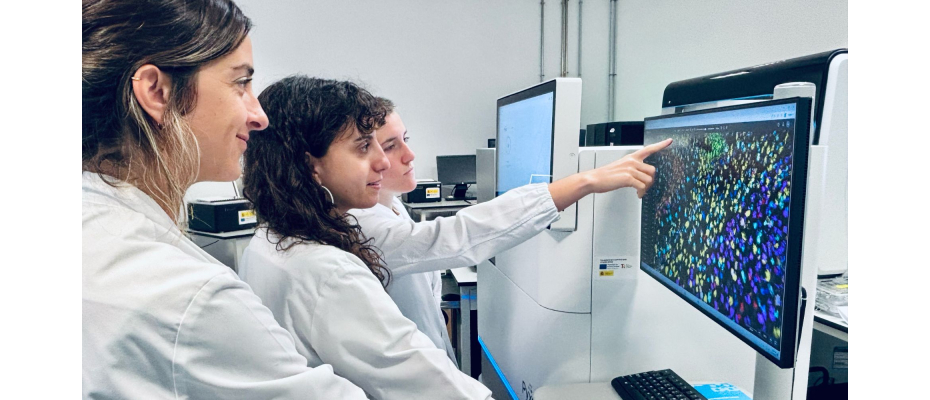
- The 3D spatial transcriptomics platform Pyxa from Stellaromics uses a technology that is unique worldwide to analyse gene activity within its three-dimensional context, placing Spain at the forefront of international genomics research.
- The innovative technology will provide a much more accurate picture of how organs function in real life, revealing previously inaccessible information about the role of individual cells within their native environment in maintaining health or triggering disease.
- The pioneering technology has been introduced at the Centro Nacional de Análisis Genómico (CNAG), a public research centre of the Spanish Ministry of Science, Innovation and Universities and the Government of Catalonia, to study complex diseases such as cancer.
September 15th, 2026. Following the publication of the human genome 25 years ago, the race to develop genomic technologies has not slowed down for a second. The latest revolution came with spatial genomics platforms, which make it possible to study cells by analysing their gene activity in their native context, directly within tissue. Now, an unprecedented advance is once again transforming the omics landscape with the launch of the first 3D spatial transcriptomics technology, capable of analysing gene expression while preserving the three-dimensional organisation of tissue. Following its launch, Spain has once again taken a leading position in cutting-edge genomic research with the installation of this pioneering platform at the Centro Nacional de Análisis Genómico (CNAG), a public research centre promoted by the Spanish Ministry of Science, Innovation and Universities and the Government of Catalonia, through the Department of Research and Universities and the Department of Health.
The new system, the first to be installed in Spain and only the third in Europe, will shed light on how cells maintain the proper functioning of the body or contribute to the development of disease. For the first time, it adds a layer of information that has until now remained inaccessible: the ability to observe cells in three dimensions, in the precise location they occupy within an organ, to understand how their position shapes their behaviour. Just as a piece of a puzzle only makes sense when viewed as part of the whole, cells can only be fully understood when studied in the context of where they reside and interact. It is precisely this new third dimension that provides a much more accurate picture of cells’ original environment, revealing more faithfully how an organ functions and bringing us closer to a more precise understanding of the biological reality of the human body.
Towards a more complete understanding of disease
The main goal of the 3D spatial transcriptomics platform Pyxa from Stellaromics is to contribute to a more comprehensive understanding of complex diseases, including cancer, immune system disorders and chronic inflammatory diseases, among others. By analysing intact tissue samples up to 20 times thicker than those that could be studied using previous spatial genomics technologies, researchers will be able to analyse a wide range of tissues and organs from patients, including primary tumours, metastases and healthy tissue. The first project is already under way and focuses on colorectal cancer, one of the most common cancers worldwide and one of the most aggressive.
“With this innovative technology, we have put on our 3D glasses to get a front-row view of how a tumour develops in a context that is much closer to reality. We will be privileged witnesses to the mechanisms underlying disease progression, seeing for the first time in three dimensions processes such as gene activation, the generation of RNA messages and the translation of this information into proteins,” explains Dr Anna Pascual Reguant, Head of the Spatial Genomics Team at CNAG. The new system will therefore enable researchers to carry out spatial transcriptomics studies, which reveal the RNA messages containing cells’ instructions, as well as spatial translatomics studies, making it possible to build a map of ribosomes and observe how these instructions are converted into the proteins that ultimately drive cellular function.
By bringing together all this key information, researchers will be able to continue advancing towards a deeper understanding of the origins and progression of a wide range of diseases, opening the door to the discovery of new biomarkers that could contribute to the development of increasingly effective and personalised therapies. In this way, Spain is once again strengthening its position at the forefront of international spatial genomics research with the installation of this pioneering platform at CNAG, home to the country’s largest genomics infrastructure, providing hospitals and research centres across Spain with access to these cutting-edge capabilities. The installation, representing an investment of nearly €500,000, has been made possible through
funding from the European Union’s NextGeneration EU funds, via the ‘Plan Recuperación, Transformación y Resiliencia’ (PRTR).