- Published in the Journal of Biomedical Semantics, ClarID is an identifier specification designed to make subject and biosample identifiers easier to interpret in biomedical research workflows.
- Developed by the CNAG, ClarID provides structured, human-readable identifiers that encode selected metadata and can be used alongside existing identifiers.
July 23, 2026. In biomedical research, a common practical challenge is linking subject and biosample identifiers to their associated metadata. Subject and biosample identifiers are generally designed to be unique rather than informative. As a result, researchers often need to consult external metadata tables to understand the context of a sample, such as its tissue, assay or disease. Although some large projects and domain-specific initiatives use structured identifiers, these systems are generally tailored to their original context. To address this practical gap, the Biomedical Genomics Group at CNAG developed ClarID. Rather than replacing persistent identifiers such as UUIDs, ClarID is intended to be used alongside them.
“The motivation for ClarID came from a very practical need,” explains Dr. Manuel Rueda, researcher at CNAG and first author of the study. “When working with large cohorts, we often had to look up external metadata tables just to understand what a sample or subject identifier referred to. ClarID was designed as a simple, automatable way to add useful context to identifiers, while keeping persistent identifiers such as UUIDs in place.”
ClarID provides two complementary formats. The first is a human-readable format whose fields depend on whether the identifier represents a subject or a biosample. For biosamples, the identifier contains project, species, subject ID, tissue, sample type, assay, condition, timepoint and duration, with optional batch and replicate fields. Subject identifiers use a separate structure containing study, subject ID, subject type, condition, sex and age group. For example, alongside an opaque persistent identifier such as a UUID, a project may use a biosample ClarID such as “CNAG_Test-HomSap-00001-LIV-TUM-RNA-C22.0-TRT-P1W”.
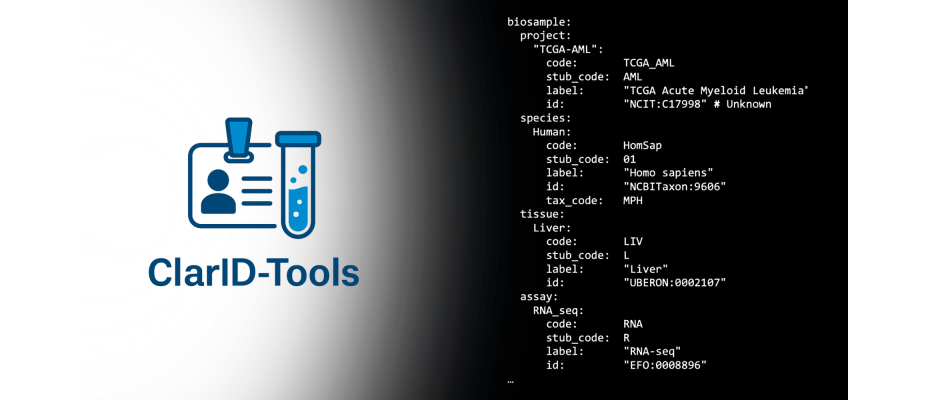
The second format, known as the stub, is a more compact representation designed for situations where shorter identifiers are useful, such as filenames, analysis pipelines, labels or QR-code workflows. ClarID is accompanied by ClarID-Tools, an open-source command-line implementation that can generate, decode and validate identifiers from tabular metadata files using a YAML-based codebook. The toolkit also supports schema validation and QR-code generation, making it easier to integrate ClarID into research data workflows. As a demonstration, the authors applied ClarID-Tools to public metadata from the
Genomic Data Commons, generating identifiers for 113,760 subject-level clinical records across 86 studies and 4,255 biospecimen records from the TARGET-AML project. The associated code, examples and reproducible materials are available through the ClarID-Tools repository and a linked Google Colab notebook.
Overall, ClarID is not intended to encode all metadata or replace laboratory information management systems, metadata repositories or persistent identifiers. Instead, it provides a lightweight companion identifier that can improve readability, support metadata curation and facilitate day-to-day data handling in biomedical and life science projects. The specification uses a configurable codebook, allowing projects to adapt it to their own terminology and requirements.
REFERENCE ARTICLE
Rueda, M., Gut, I.G. ClarID: a human-readable and compact identifier specification for biomedical metadata integration. Journal of Biomedical Semantics 17, 9 (2026).
DATA AVAILABILITY
A copy of the downloaded input data, together with the processed results and scripts, is available through the
ClarID-Tools GitHub repository and can be reproduced via the linked Google Colab notebook.