- The new method reveals a hidden layer of cancer biology: the metabolic strategies of its cells, which may drive tumour growth, immune evasion or disease progression depending on where they are located within the tissue.
- The first metabolic maps identify tumour regions, or niches, that consume lactate in colorectal cancer, both in primary tumours and liver metastases. In kidney cancer, by contrast, lactate production predominates, although this behaviour varies across different areas of the tumour.
- The study, published in Systems Biology and Applications, a Nature Portfolio journal, was coordinated by the University of Milano-Bicocca (Italy) and the Centro Nacional de Análisis Genómico (CNAG), in collaboration with Yale School of Medicine (USA).
September 3rd, 2026. Tumours are made up of vast numbers of cells whose primary objective is to multiply while escaping the immune system. Each cell plays a specific role within this complex network, where the activity of their genes determines the function they perform. This genetic information has already transformed our understanding of cancer biology since the advent of high-resolution genomic technologies, and further advances came with spatial transcriptomics, which made it possible to pinpoint different tumour cell types and their patterns of gene expression directly within tissue. Now, a new computational tool developed by the Centro Nacional de Análisis Genómico (CNAG) and the University of Milano-Bicocca takes this one step further by uncovering information that has until now remained inaccessible: the metabolic reactions carried out by individual cells in their native tissue context, including not only tumour cells but also the immune and structural cells that make up the tumour microenvironment. The tool enables researchers to map the metabolic strategies that underpin tumour growth and survival.
"Our aim was to understand how a cell's location within a tumour influences the way it acquires energy and nutrients. We already knew which genes were active in individual cells, so we asked ourselves: what if we could also mapcell metabolism? In other words, we can aggregate their gene expression, to infer their metabolic activities such as, cell growth, survival and spread" explains
Dr Davide Maspero, researcher at CNAG and first author of the study. To address this question,
the team developed the spatial Flux Balance Analysis (spFBA) method in collaboration with the
University of Milano-Bicocca (Italy) and
Yale School of Medicine (USA). Published in
Systems Biology and Applications, a
Nature Portfolio journal, the new computational framework
enables, for the first time, the reconstruction of spatial metabolic patterns from spatial transcriptomics data, capturing both cancer cells and the surrounding tumour microenvironment.
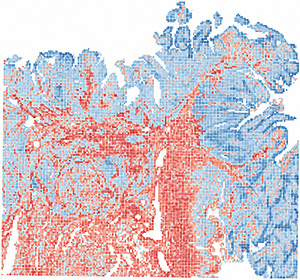
The resulting maps reveal the metabolic reactions taking place across different tumour regions, or niches, showing which areas rely more heavily on glycolysis to generate energy, which show greater resources to biomass production for growth and cell division, and which consume or release lactate, a key molecule that cells can use both as an energy source and as a precursor for the synthesis of new cellular components. These metabolic profiles act as landmarks within the tumour, allowing researchers to infer the dominant biological activities in different regions and estimate their proliferative potential. The findings uncover the metabolic strategies tumour cells use to proliferate, and spread to other organs,
opening the way to improved predictions of tumour evolution and the development of more targeted therapies.
First metabolic maps of colorectal and kidney cancer
Considering the metabolic plasticity of colorectal cancer, a characteristic that makes it one of the most aggressive tumour types because of its remarkable ability to adapt the way it acquires energy and nutrients, the researchers began by analysing samples from patients with colorectal cancer and liver metastases. Their goal was to gain a deeper understanding of the mechanisms that enable tumours to spread and colonise distant organs. The resulting metabolic maps revealed that certain tumour regions consumed lactate to generate energy and produce tumour biomass, whereas the surrounding non-tumour tissue, or stroma, primarily produced lactate. Taken together, the findings show how tumours establish a highly organised network of metabolic cooperation between different regions, with some producing nutrients that others consume, thereby supporting continued tumour growth.
In kidney cancer, spatial analysis using spFBA confirmed the widespread presence of tumour regions with high levels of lactate production, a pattern consistent with the Warburg phenotype. This phenomenon describes the tendency of cancer cells to preferentially generate energy by fermenting, glucose even when oxygen is available.
However, the analysis also revealed that this behaviour is far from uniform across the tumour. While some regions continued to produce and secrete lactate despite the presence of oxygen, others displayed the metabolic profile typically associated with oxygen-poor environments, relying more heavily on anaerobic glycolysis. Once again, different parts of the tumour adopt distinct metabolic strategies to achieve the same outcome: sustaining disease progression.
Following these first metabolic maps, which highlight the crucial role of tumour spatial organisation in securing the resources required for continued growth, the researchers are already working on the next stage of the project. The team is developing a new version of the spFBA software that will be compatible with a broader range of spatial transcriptomics datasets, making it easier for research centres and healthcare institutions worldwide to incorporate this computational tool into their own analyses.
IMAGES
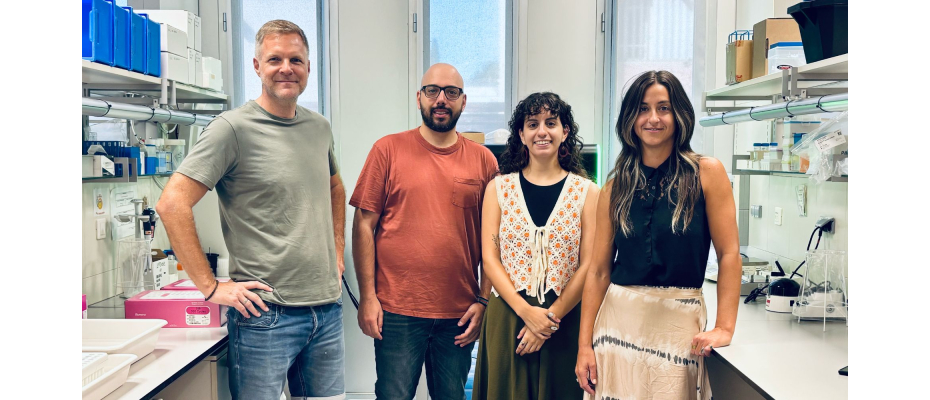
1- CNAG Researchers involved in the study (from left to right): Dr Holger Heyn, Dr Davide Maspero, Irene Ruano and Dr Anna Pascual.
2- Lactate consumption (blue) and production (red) in colon adenocarcinoma tissue, inferred by spFBA.
REFERENCE ARTICLE
Maspero, D., Marteletto, G., Lapi, F. et al. Spatial FBA reveals heterogeneous Warburg niches in renal tumors and lactate consumption in colorectal cancer. npj Syst Biol Appl 12, 32 (2026).
https://doi.org/10.1038/s41540-026-00654-x