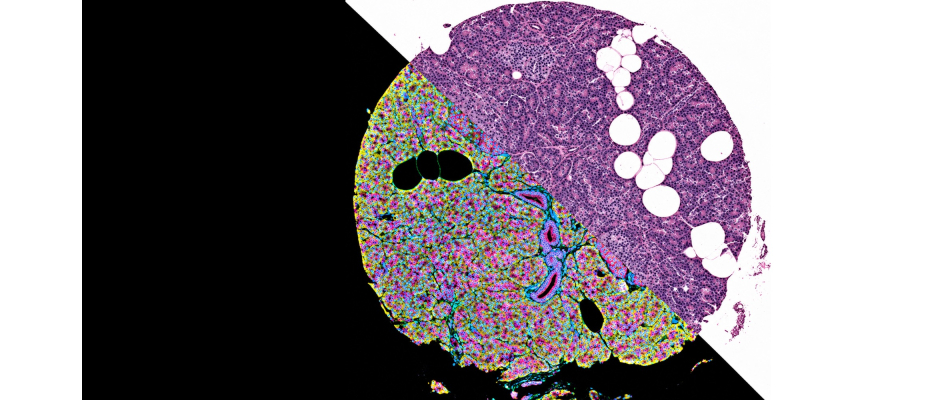
- The map of this key organ of the digestive system analyses more than four million cells and cell nuclei from pancreatic tissue samples donated by 57 people, covering different stages of life, from fetal development to healthy adulthood, as well as type 2 diabetes (T2D).
- The single-cell multiomics atlas, published in Cell Metabolism, offers the most comprehensive picture to date of the diversity and adaptability of pancreatic cells, at an unprecedented scale and level of detail, helping researchers understand how the pancreas functions and responds to disease.
- The valuable resource was developed as part of the Human Cell Atlas project through an international collaboration coordinated by the Berlin Institute of Health at Charité (BIH), with the participation of the National Centre for Genomic Analysis (CNAG) and the Josep Carreras Leukaemia Research Institute (IJC).
October 22, 2026. The human pancreas is much more than a vital organ for digestion and blood glucose regulation, it is also a remarkably adaptable organ whose changes can play a role in the development of diseases such as type 2 diabetes. For years, scientists have been trying to understand how pancreatic cells adapt and change in response to different conditions, an ability known as cellular plasticity. Now, a new study published in Cell Metabolism provides the most comprehensive single-cell atlas of the human pancreas to date, offering new insights into how this organ functions in health and disease, and taking us one step closer to understanding the complexity of human biology.
The new cell map is the result of an international research collaboration within the Human Cell Atlas initiative. The consortium aims to map the human body, cell by cell, creating the first comprehensive atlas of the more than 37 trillion cells that make up the human body. This is a crucial step towards understanding human biology and tackling disease.
“Today, the combination of genomic technologies gives us an unprecedented window into how the human body works. For the cellular atlas of the human pancreas, we brought together ten complementary techniques, including transcriptomics, chromatin accessibility and multiplexed proteomics, allowing us to look at what cells are doing, how they are regulated and where they are located within the tissue. Bringing all these layers together gives us a much more complete picture of pancreatic biology and reveals the extraordinary ability of pancreatic cells to adapt,” says Dr Holger Heyn, Single Cell Genomics Group Leader at CNAG and ICREA Research Professor.
A new rare cell population with a remarkable ability to adapt
Among the more than four million cells and cell nuclei analysed from pancreatic tissue samples donated by 57 people across fetal development, healthy adulthood and type 2 diabetes (T2D), researchers made an intriguing discovery: a previously unknown rare cell population in the human pancreas. The finding emerged from an unexpected observation. Researchers noticed cells showing features of both acinar cells, which produce digestive enzymes, and ductal cells, which help transport pancreatic secretions. These cells resembled centroacinar cells, a population that had remained poorly characterized in previous single-cell studies. Further investigation revealed a rare population with elevated expression of genes associated with acinar-to-ductal metaplasia (ADM) and cellular plasticity. The researchers named these cells plastic centroacinar-like cells (pCACs).
These results suggest that the adult human pancreas retains a population of cells with a high degree of plasticity, potentially poised to respond to injury or changing conditions. This could have important implications for understanding how the pancreas repairs itself and how abnormal changes may contribute to disease.
A closer look at the pancreas in type 2 diabetes
To explore how pancreatic cells respond to metabolic stress, the researchers exposed healthy pancreatic islets, small clusters of hormone-producing cells known as the islets of Langerhans, to high levels of glucose. The experiment showed that different types of pancreatic cells respond differently to these conditions, providing new insights into how the cellular composition and function of the pancreas can change in metabolic disease. In people with type 2 diabetes, the researchers also identified altered molecular markers in beta cells, the cells responsible for producing insulin, including changes in the expression of genes that regulate their function.
“What excites me most about this study is that it reveals a much more dynamic picture of the human pancreas than we previously appreciated. We identified rare transitional cell states that challenge the classical boundaries between pancreatic cell identities, suggesting that cellular plasticity is an intrinsic feature of the healthy organ. With ESPACE we now have a reference to investigate what these states actually do, how they respond to stress and injury, and what role they might play in regeneration and disease.”, explains Dr Elisabetta Mereu, Group Leader at the Josep Carreras Leukaemia Research Institute.
Supported by
ESPACE, the Expression and Spatial analysis Pancreas Atlas Consortium Europe, with funding from the European Commission, this atlas provides a valuable resource for the scientific community, helping researchers explore how pancreatic cells adapt and respond to change, one cell at a time. These insights could advance our understanding of metabolic diseases and support the development of new diagnostic and therapeutic approaches for type 2 diabetes and regenerative medicine.
REFERENCE ARTICLE
Mereu, Elisabetta, et al. ‘A Single-Cell Multi-Omic Atlas of the Human Pancreas Reveals Potential for Cellular Plasticity across Development, Health, and Disease’. Cell Metabolism, vol. 38, no. 9, Sept. 2026, pp. 1896-1915.e12. DOI.org (Crossref),
https://doi.org/10.1016/j.cmet.2026.07.023.
IMAGE
A spatially-resolved pancreas atlas.