Home » News » MICIU and CNAG celebrate the 25th anniversary of the Human Genome Project
MICIU and CNAG celebrate the 25th anniversary of the Human Genome Project
February 11th, 2026.MICIU and CNAG, together with the European initiative EASIGEN-DS, yesterday marked the 25th anniversary of the Human Genome Project at an event in the Ministry’s Assembly Hall. The Project was an international scientific milestone that revolutionised modern biomedicine following the publication in 2001 of the first draft of the book of life’s instructions in the journals Nature and Science.
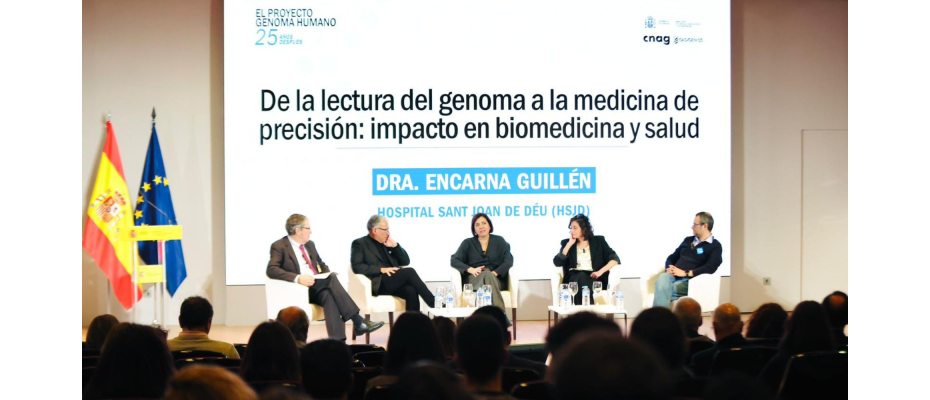
The commemorative event, entitled “El Proyecto Genoma Humano, 25 años después”, brought together over 200 participants, including in-person attendees and those joining via livestream. It featured leading national figures in genomics such as Dr Ivo Gut (CNAG), Dr Roderic Guigó (Centro de Regulación Genómica, CRG), Dr Encarna Guillén (Hospital Sant Joan de Déu, HSJD), Dr Fátima Al-Shahrour (Centro Nacional de Investigaciones Oncológicas, CNIO) and Dr Tomàs Marquès-Bonet (Instituto de Biología Evolutiva, IBE UPF-CSIC).
The institutional opening was delivered by Eva Ortega Paíno, Secretary General for Research at MICIU, highlighting the Ministry’s sustained commitment to cutting-edge genomics, centred on CNAG, established 15 years ago as Spain’s first public institution dedicated to large-scale genomic sequencing and analysis. In her words: “CNAG’s work has significantly expanded molecular knowledge of numerous tumours, including breast and colorectal cancer, helping to improve prevention, diagnosis and treatment through a far more precise and increasingly personalised approach.”
25 YEARS OF GENOMICS: FROM EARLY BREAKTHROUGHS TO TOMORROW’S CHALLENGES
In his presentation, ‘Past, present and future of genomics’, Dr Ivo Gut, Director of CNAG, offered a historical overview of the major milestones that have shaped genomics over the past 25 years, from the foundations of heredity established by Gregor Mendel to the latest generation of genomic technologies. Dr Gut underlined the immense effort involved in obtaining the first human genome sequence, an international project involving 20 centres and more than 1,000 researchers worldwide, requiring nearly 13 years of work and an investment of 2.7 billion dollars.
Over this first quarter-century, technological advances have been exponential. Today’s sequencing instruments can generate more than one hundred complete human genomes in just 24 hours. Thanks to this progress, Spain has been able to participate in high-impact international initiatives such as the International Cancer Genome Consortium, the 1+ Million Genomes project, the European Reference Genome Atlas and the Human Cell Atlas. The country has also moved from conventional genomic analyses towards single-cell and spatial genomics approaches, opening new frontiers for biomedical research.
In this context, Dr Gut added: “At CNAG, we have developed methods that combine single-cell and spatial genomics techniques in a cost-effective way to detect ultra-rare cell populations. This approach captures the complexity and plasticity of cells and tissues, both in health and in disease.”
Dr Gut also highlighted the main future challenges for genomics, including promoting equitable access to next-generation genomic technologies, a central objective of the European project EASIGEN-DS, coordinated by CNAG. This initiative aims to lay the foundations for the first European infrastructure for advanced genomic technologies, integrating the sequencing capacities of thirteen European centres with a combined capability of more than 300,000 human genomes per year.
THE LEGACY OF THE HUMAN GENOME PROJECT THROUGH LEADING EXPERTS IN GENOMICS
The commemorative event brought together some of Spain’s foremost genomics experts in a dialogue on how the Human Genome Project has transformed science and medicine. The round table opened with testimony from Dr Roderic Guigó (CRG), one of the two Spanish researchers who participated in the historic project. Dr Guigó shared the challenges and lessons involved in drafting the first version of the human genome, recalling the scale of the international effort that permanently changed modern biology.
Dr Encarna Guillén (HSJD) then explained how the Human Genome Project has opened new frontiers in precision medicine and transformed the fight against rare diseases and cancer. Dr Fátima Al-Shahrour (CNIO) illustrated how the combination of bioinformatics and artificial intelligence now allows genomic data to be interpreted with a depth unimaginable just 25 years ago, enabling complex information to be translated into clinically useful knowledge.
The round table concluded with Dr Tomàs Marquès-Bonet (IBE – UPF/CSIC), who broadened the perspective beyond humans. He highlighted how comparative and evolutionary genomics helps us understand the planet’s genetic diversity and opens new research opportunities, showing that the impact of the Human Genome Project continues to grow and expand into new frontiers of knowledge.
The commemorative event closed with Juan Cruz Cigudosa García, Secretary of State for Science, Innovation and Universities, pointing out one of the most important lessons of this landmark achievement: “This project taught us that cooperation makes the impossible possible. It demonstrates that sharing data leads to success and multiplies progress.” He also emphasised the enduring relevance of the Human Genome Project’s legacy, which “brought about a radical transformation in research and its ecosystem, and continues to open new pathways today.”